Earth's Temperature - November 2025

In this newsletter:
Global Conveyer Belt Keeps Earth Warm
Books on Writing
Writer’s Corner

GLOBAL CONVEYOR BELT KEEPS EARTH WARM
When I taught Earth Science, at the beginning of my teaching career, I used to tell students the average temperature of our planet is a toasty 59°F (15°C). That may not sound toasty unless you compare it to our nearest planetary neighbors. Venus broils along at 900°F (480 °C). Mars has a frigid daily average of -80 °F (-60 °C). Why do I mention the average temperature of our planet?

I needed a map for my novel, “A Choice of Sides,” which meant I needed to figure out where to place the continents on my fictional world. I knew the oceans have a lot to do with keeping our planet warm because they circulate a tremendous amount of heat. Sun-warmed equatorial waters constantly flow to the poles. At the same time, cold arctic and Antarctic waters drop deep in the oceans, in a process called thermohaline circulation, then surge back to the equator. For example, if a surface current like the Gulf Stream failed, much of Europe’s temperatures would plummet.
This got me to thinking about the shape and placement of the continents after the Flood. We know there was a supercontinent in the past that broke apart due to plate tectonics. That’s because fossils of plants and animals, mountain ranges, the composition of rock layers, etc., match across the continents. Also, it's easy to see that South America and Africa fit together like the pieces of a jigsaw puzzle.
In trying to draw a map for my fictional planet to keep it warm enough for humans (it’s a cold world), I quickly saw the shape and the placement of the continents on our planet was not random! Our amazing God designed and placed the continents in just the right locations, with just the right shapes, to keep our planet habitable.
So, I did a little research. Google’s Gemini AI said, “the current configuration of the continents is a result of God's initial design.” But none of the sources elaborated on the design part.
I moved over to the AI Perplexity, which I like better, and got better results. It gave me this source: “Seeing God’s Ingenuity in Earth’s Design” https://stonestruestory.org/?page_id=4020
“. . . the placement and size of the continents also show the forethought and ingenuity of God . . . “
In the Northern hemisphere, the surface ocean current in the equator is warmed as flows along Central America and into the Gulf. If North and South American weren't joined, the warm ocean current wouldn't flow up to Great Britain and keep Europe warm. The separation between Alaska and Russia then allows deep, cold arctic waters to flow south and keep equatorial regions from becoming too hot.
In the Southern Hemisphere, the wedge-shaped Brazilian coast directs the warm, equatorial surface current down to cold Antarctica. The separation between South America and Antarctica then allows for some of the cold, subsurface Antarctic waters to flow up the coast of South America and again keep areas near the equator from becoming too warm.

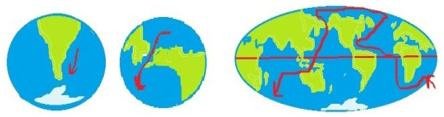
Not only the placement, but the shape of the continents, argues for a Designer. King David said, “The Heavens declare the glory of God.” (Psalm 19:1 - ESV). The continents and even their shapes, declare His glory as well.
BOOKS ON WRITING
I’m always reading books on writing. Here are two that were highly recommended by Steve Laube of Enclave Publishing. (Yes, one of them is co-authored by Laube. But, he's been in the Christian book industry for 40 years, so it's good guess he knows what he's talking about.)
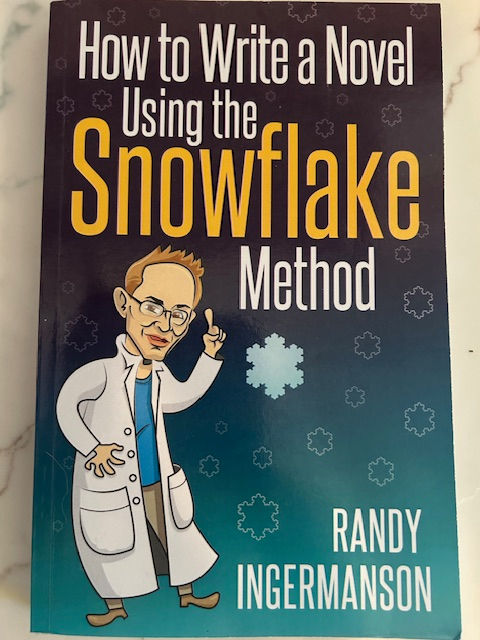
This is a step-by-step method for writing a novel. If you have no idea where to begin, or need help fleshing out a work-in-progress (WIP), this will walk you through the basic beats of a story so you don't waste a lot of time rewriting.
It starts out rather simplistic. Then it returns to the previous steps and asks you to go deeper and more fully explore each one. Working through the exercises is intended to leave you with a finished draft.

Included in this book are lots of writing strategies with exercises at the end of each chapter to practice them.
I liked this book better because it seemed more advanced. Examples on ensuring dialogue is realistic, using setting to enhance the story, show, don't tell, and most importantly using emotion in each scene to hook your reader.
WRITER'S CORNER

I mentioned above that I needed a map for my science fiction novel. That meant I needed to hire a cartographer (map maker). The high school where I used to teach has an amazing art department. Every year the students’ work was put on display and I was always astounded by the their professionalism.
To make a long story short, I contacted the high school art teacher and hired one of his seniors to turn my rough draft into a finished map. I’ll keep you posted.
I also need to hire an illustrator. Since the book’s cover is my main marketing tool, I need a professional. I let my writer’s group, the Lady Lits, know. Sarah Soon put me in touch with someone she knows. It turns out this illustrator has worked for the fantasy/science fiction publisher Enclave and they’ve always done what, I think, are the best covers in the business. I’ll keep you posted on this one too as soon as I hear back.
Cynthia Zager Godwin - Copyright 2025


Comments